|
|
 |
Any trouble with Google Scholar?
Google Scholar
403. That's an error.
Too many searches, please try again later
That's all we know.
Google Scholar
403. Leider ist ein Fehler aufgetreten.
Zu viele Suchanfragen. Bitte versuchen Sie es später erneut.
Es sind keine weiteren Informationen verfügbar.
Google Scholar
403. Il s'agit d'une erreur.
Nombre de recherches trop élevé. Veuillez réessayer ultérieurement.
C'est tout ce que nous savons.
403. To jest błąd.
Zbyt wiele wyszukiwań. Spróbuj ponownie później.
Nic więcej nie wiemy.
Google Académico
403. Es u error.
Demasiadas búsquedas, vuelve a intentarlo más tarde.
Es todo lo que sabemos.
Академия Google
403. Ошибка
Вы отправили слишком много поисковых запросов. Повторите попытку позже.
Повторите попытку
Google Scholar
403. Dat is een fout.
Te veel zoekopdrachten, probeer het later opnieuw
Dat is alles wat we weten.
Google Scholar
403. Dette er en feil.
For mange søk. Prøv igjen senere.
Det er alt vi vet.
Baptiste Auguie This email address is being protected from spambots. You need JavaScript enabled to view it. v1.3, 2013-01
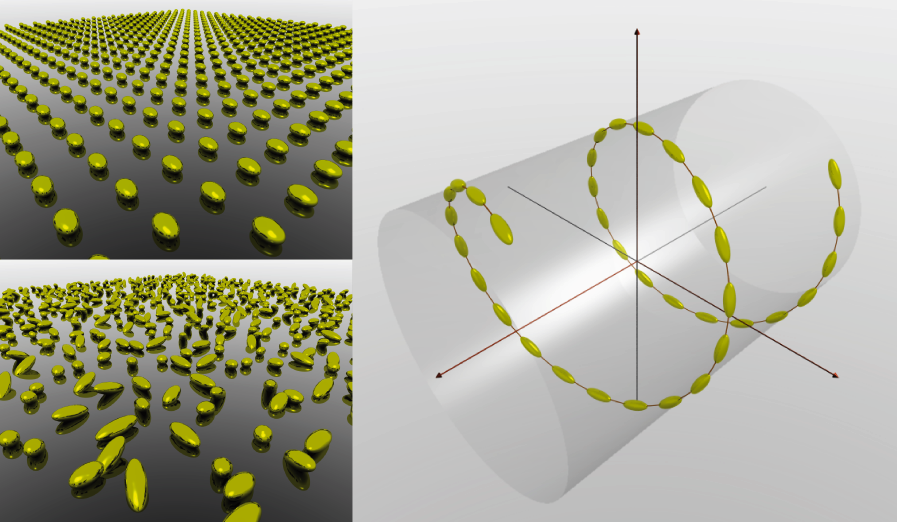
Ray-tracing rendering of 3D clusters of plasmonic nanoparticles with arbitrary positions, sizes, and orientations.
Brief description
The cda package implements the coupled-dipole approximation for electromagnetic scattering by sparse collections of subwavelength particles, with a particular focus on plasmonic nanoparticles in the visible regime. The interaction matrix, and the solution of the linear system of coupled-dipole equations are executed in C++ code for speed; convenient wrapper functions are provided at the R level to generate the particle clusters, calculate the extinction, scattering, and absorption of light by particles with linearly and circularly polarised light. Functions are also provided to calculate orientation-averaged circular dichroism, and display clusters of nanoparticles in three dimensions using OpenGL or povray.
Read more ...

ScattPort 17. Aug. 2009
Erythrocyte shape
Thomas Wriedt
Email: This email address is being protected from spambots. You need JavaScript enabled to view it.
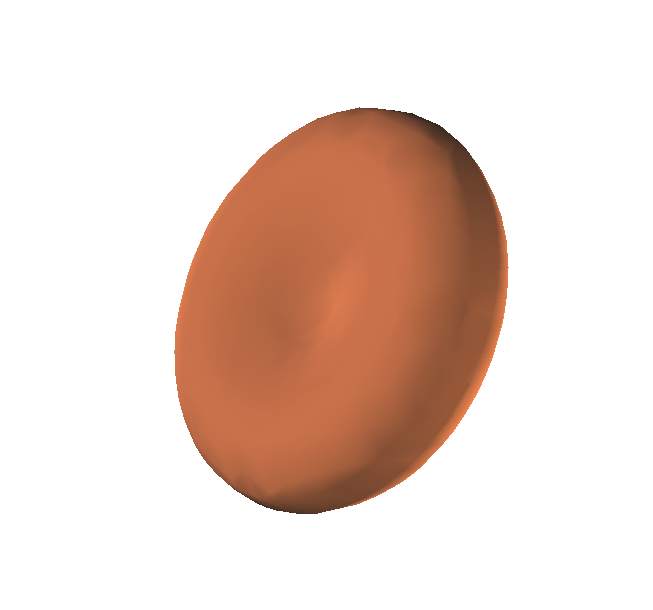
To compute light scattering by the erythrocyte or red blood cell (RBC) various computer programs are available such as DDSCAT, ADDA, MMP3D and many FDTD programs [1]. To describe the shape of the erythrocyte the implicit equation given by Kuchel and Fackerell [2] is suitable:
(x^2+y^2+z^2)^2+P*(x^2+y^2)+Q*z^2+R=0
Read more ...

ScattPort 9. March 2009
Near field computations
Thomas Wriedt
Email: This email address is being protected from spambots. You need JavaScript enabled to view it.
Recently there seems to be increasing interest in computing the near field or the internal field by scattering particles. There is especially interest in morphological resonances and in plasmon resonances. There are not that many programs available which focus on near field computation.
The T-Matrix programs by P. W. Barber and S.C. Hill allow simulating the internal and external intensity distribution by a scattering sphere.
Near field and internal field computations of a spherical particle in a Gaussian laser beam can be done using the Windows program GLMT Champ Internes by Loic Mees. The Fortran program bhfield by Honoh Suzuki can be used to compute the nearfield inside and outside of a coated sphere. This Fortran libery can also be used to compute near fields.
If you like to compute near fields by a number of scattering spheres you can use the extension of Yu-lin Xu's GMM program by Moritz Ringer. He extended GMM working on his PhD thesis [1]. His Fortran Program GMM-Field allows computing the near field. GMM-Dip gives the near field with a dipole as incident field. Apparently Giovanni Pellegrini did a similar extension of the GMM program in this PhD thesis [2]. The LightScatPro matlab program by Sylvain Lecler used for his thesis [3] is also suitable for near field computation by a number of spheres.
To compute near fields by arbitrarily shaped particles you can off cause apply any FDTD program but other programs have recently also been extended for efficient near field computation. There is DDSCAT by Bruce Draine and Priotr Flautau. This program now allows near field computations. Another variant of the program DDA_field by Serdar Ogut and Juan C. Idrobo also gives near field results.
The Fortran program MMP 3D by Christian Hafner, Lars Bomholt is also very well suited to compute near field by scattering nonspherical particles. There is a new version of this program including a GUI called OpenMaX.
References
[1] Moritz Ringler: Plasmonische Nahfeldresonatoren aus zwei biokonjugierten Goldnanopartikeln. Dissertation Ludwig Maximilians Universität, München 2008.
[2] Giovanni Pellegrini: Modeling the optical properties of nanocluster-based functional plasmonic materials. Tesi di dottorato, Università degli Studi di Padova, Padova 2008.
[3] Sylvain Lecler: Etude de la diffusion de la lumière par des particules sub-microniques. Thèse. l’Université Louis Pasteur, Strasbourg 2005.
Some links
DDSCAT and electric field at plasmon resonance

|
|
|
|